Everything you need to know before heading to Margalef
Words & photography by Caro & Eduardo, Climb & Relax co-founders
Whether it’s for its 1,800+ routes, the huge variety of sectors, or the fact that it hosts some of the hardest lines in the country, Margalef has more than earned its reputation as one of Catalonia’s most iconic climbing destinations.
That popularity has also brought change. In recent years, the local council has introduced a few measures (not always popular), including access barriers in the two main valleys where most sectors are concentrated. In this guide, beyond helping you understand what makes Margalef so special, we’ll explain clearly how access works today—so you can plan your visit without surprises.

Margalef at a glance (quick facts)
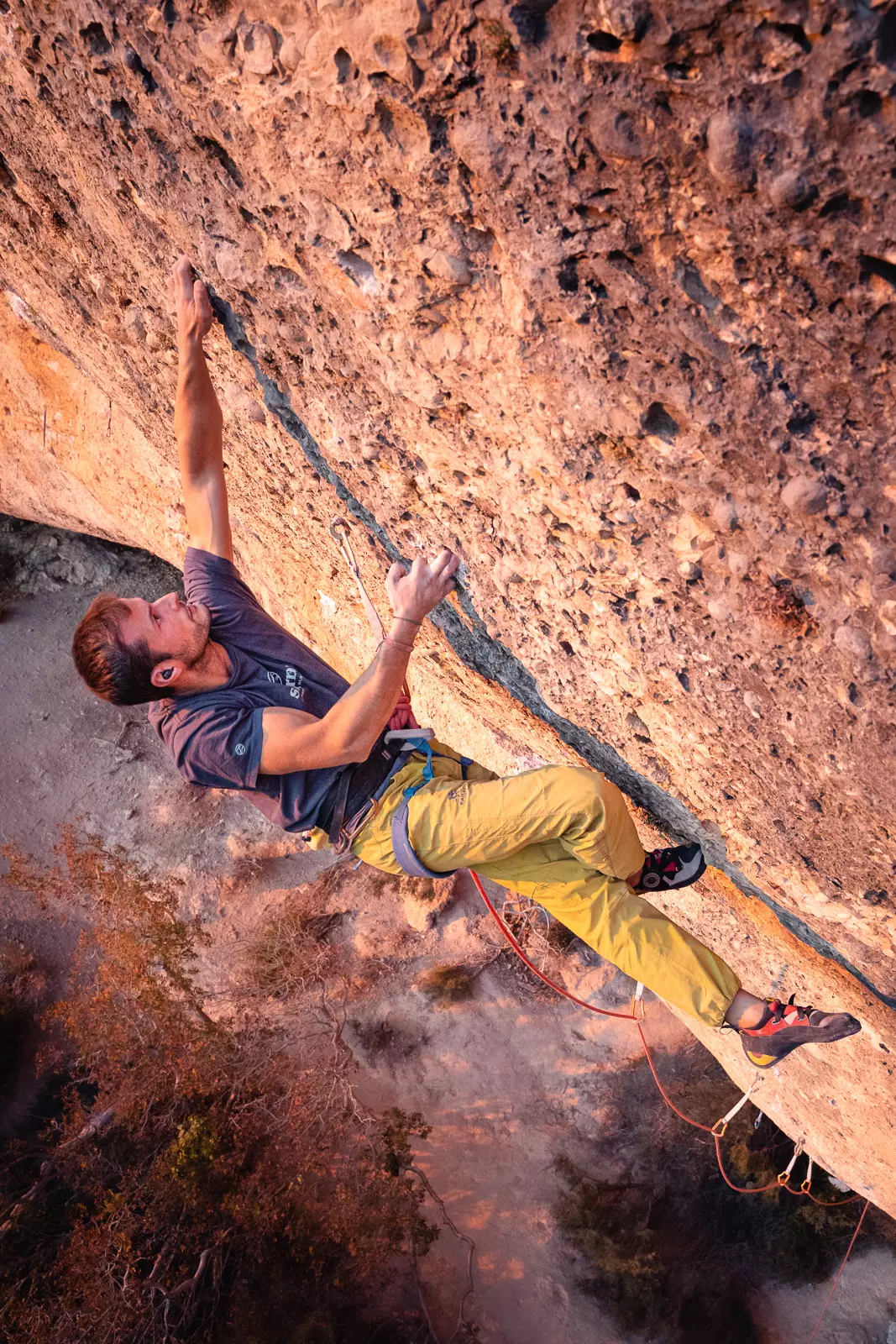
Margalef is a conglomerate crag where climbing often blends two distinct rock “moods”: on the lower sections of many routes you’ll find orange rock with pockets everywhere (good ones and not-so-good ones), usually well-seasoned with chalk; higher up, the rock often turns into excellent grey stone—compact, clean, and a real pleasure to climb once you’ve got the route under control.
The latest guidebook lists 95 sectors, which translates into options for almost any time of year, all ability levels, and a surprising range of styles within one single area.
After a full day on the rock, the plan is easy: climber atmosphere, good conversation, and a beer at Cafè Vernet, right in the village square.


What climbing feels like in Margalef (style & rock)
If you’re not used to pocket climbing, Margalef can feel a bit “strange” for the first couple of days. But once your body adapts to the two-finger pockets and you start reading sequences properly, it will very likely become one of your favorite crags.
Most routes don’t go beyond 20–25 meters. The climbing is mainly about continuity and endurance, with short, physical sections to get through small roofs or angle changes.
And if it’s your first time here, one tip from experience: save some skin—you’ll need it tomorrow.
Best season & conditions (sun/shade strategy)
One of Margalef’s biggest advantages is the variety of sector aspects and elevations. That means you can climb almost all year round—if you choose the right sector for the day: sun, shade, wind, or temperature.
On top of that, Margalef’s grey rock doesn’t hold much water and tends to dry quickly after rain. With a few hours of sun, it’s common to find plenty of routes in great condition.
- Winter and cold days: sunny sectors often work brilliantly, such as Espadelles, Laboratori, or Balcó de l’Ermita.
- Spring and autumn: this is when Margalef is at its best. You’ll find a huge variety across grades and sectors—Culample, Racó de la Finestra, Can Dit Xic, or Can Dit Gros, to name a few.
If you’re visiting during late spring or early summer, we also created a detailed guide to the best sectors and routes for climbing in Margalef in May and June, including ascent statistics, grade distribution, shade considerations and recommendations based on 8a.nu data and local experience. - Hot days (late spring/summer): this is where El Torroner shines. High above the Sant Salvador valley and in the shade for much of the day, you’ll find three walls with different styles: Curtes del Torroner, Llargues del Torroner, and Balcó del Torroner (a true gem if you want to enjoy some of Margalef’s best 8s on a slightly overhanging wall).

Access & current regulations (read this first)
Since 14 October 2025, to access Margalef’s two main valleys by car you need a reservation with a QR code.
The official information is published in this council notice.
If you access on foot or by bicycle, you don’t need a reservation.
How the QR system works (quick overview):
The price is €5 per day, per vehicle (regardless of the number of passengers). On the booking page you must choose: Sant Salvador Valley or l’Embassament Valley.
With the same QR you can access both areas and switch between them on the same day (according to the published information).
Get your QR code in:


Guidebook & local ethics (support the area)
You can find Margalef topography in printed guidebooks and in digital apps. At Climb & Relax we always encourage supporting local work, so we recommend getting the “Margalef Climbing Guidebook 2024” by Vicent Palau and Maya Ayupova (available in Spanish and English).
Besides being the most complete and up-to-date guide, it contributes to local rebolting thanks to Vicent Palau’s continuous work. You can buy it at Cafè Vernet or at La Botiga in Margalef.
And like in any natural area, a simple (but important) reminder:
- Leave the place how you’d like to find it.
- Respect the designated parking areas and remember you’re in an agricultural zone: don’t block access to fields or tracks.
- Brush the holds when you lower off — chalk doesn’t clean itself.
- If you need the toilet, move away from the crags, dig a deep hole, and take your paper out with you. Nobody likes unexpected “surprises”.


FAQ
Best time to visit Margalef?
The best seasons are usually from autumn to spring. The Priorat isn’t a particularly rainy area, so you can normally plan with a fair amount of confidence. In summer you can still climb in the shade, but if your goal is comfort and top conditions, there are better crags for that time of year.
Is Margalef recommended for beginners?
Yes. There are sectors with friendlier routes to get started, such as Can Llepafils or Els Cingles del Molí. And if you want to explore more styles, combining Margalef with Siurana is a great way to discover outdoor climbing and experience very different terrain. If you want to plan both smoothly, check our climbing in Catalonia overview.
Do I need a car?
Getting to Margalef by public transport isn’t easy. Once you’re there, depending on where you stay and which valley you want to climb in, you might manage on foot—but in general, a car helps you make the most of your time. If you don’t have one, it’s not unusual to find a ride: the vibe is social, and there’s usually movement towards the two main valleys.
What if it rains?
In many cases, the rock dries quickly and with a few hours of sun you’ll find plenty of routes in good condition. If the day stays humid or you’re forced into shade, conditions will be more demanding—but there’s almost always a way to “save the day” by choosing the right sector.
Can I fly my drone in Margalef?
In general, flying a drone in the Margalef area is prohibited, and you need a permit for flights and filming. Margalef lies within the Serra del Montsant Natural Park, so the park’s regulations apply. If you need to fly, check the official rules and request the relevant authorization through the Generalitat (Gencat) website.
Planning a trip to Margalef?
Discover Margalef your way with our personalised and guided climbing trips — from accommodation and logistics to the right sectors for your level.
Tell us how you’d like to be contacted and we’ll take care of the rest.